Friday, May 22, 2015

Necessity of Self Diagnosis and Acknowledging Its Value and Validity

(Quoted insight from friends peppers this piece. Though it's been arranged to relate to surrounding text, I’ve chosen not to set up each paragraph of dialogue with a formal segue.)

We place a lot of faith and trust in doctors who’ve spent so many years becoming experts in their respective fields. To think that just a few hundred years ago we had little recourse but to act independently on what knowledge we could glean from our own research and experiences and those of our neighbors. . . . Just like we treat most common ailments today. We become very knowledgeable about the things we experience regularly, and we easily pick up treatments from convenience, grocery, and drug stores. Yet we as a society largely disparage self diagnosis and self medication of mental disorders.

“OTC medications exist because you can self diagnose a bunch of shit and treat it without seeing a doctor. Yeast infection. Dehydration. Heartburn. Diarrhea. Constipation. Aches and pains. But suddenly that stuff all doesn't matter when it's other kinds of health? NOPE.” —Elyse “Mofo” Anders

Earlier this week a now-former Facebook “friend” asserted that when people tell him of their self-diagnosed PTSD or bipolar disorder, he knows that what’s wrong with them is not either of those things but that they are “idiots.” This attitude toward self-diagnosis is unfortunately all-too prevalent and contributes to furthering the stigma against mental illness in the first place by silencing those who do not or can not obtain a professional diagnosis for whatever reason.

“Misdiagnosis happens even when professionals are on the job.” —Danielle St. Johns

Self diagnosis is not inherently invalid, ignorant, or inaccurate. Yes, some people mess it up with the help of WebMD and determine themselves to have any and every ailment imaginable, but so do doctors all the time. To assume that every layperson is too ignorant to identify their own ailments is absurd.

“I have a hard time believing that any doctor understands what I think and feel and the way I think and feel better than I do. Anybody who does instantly has me suspicious.” —anonymous

You don't roll your eyes and dismiss a person who says they have the flu or a mildly sprained wrist if they haven’t seen a doctor yet, so why is mental illness different? A person knows what they're going through, and frequently doctors end up making things worse.

“The major difference is there's a lot, even in the medical profession, who don't believe mental illnesses [exist]. . . . Family history and years of doing in-depth research on what I have and don't have, and yet I'm supposed to take the opinion of a doctor who looks at one five minute survey and comes up with a different conclusion?” —Sascha Adeen Sinopa

Testing and treatment are prohibitively expensive to get, and the illness itself and surrounding stigma can create “long delays−sometimes decades−between the first appearance of symptoms and when people get help.

It took me over a decade to seek treatment for anxiety and depression. That doesn't mean I didn't know what it was before then. I found moderate success in managing both through exercise and talk therapy with friends. Should I have gotten a doctor's note to allow me to talk about my own mental health with others?

Even seeking treatment can cost people their jobs, future prospects, families, friends, and significant others, to say nothing of the financial cost and emotional strain of auditioning doctors and undergoing multiple tests.

“It has taken a proverbial army of counselors (5+), shrinks (4+), and doctors(5+) to get [a holistic diagnosis] over time. Oh, and my own degrees, one heavy on psych, and now a nearly complete nursing degree. That's a lot of time, energy, and privilege to be able to access that amount of care over the past 19 years.
So when people self-diagnose, I completely understand why, and am far more reticent to judge their motives or conclusions.” —anon

It's very different to say, for example, “I find it frustrating/unfortunate that misdiagnosis is so common,” or “It sucks that people can't get the treatment they need for whatever reason,” than to call the self-diagnosed “idiots,” drama queens, “special snowflakes,” and attention seekers.

"One thing I've found upsetting when talking to people who either don't understand mental illnesses or have a negative view, is that if they even believe it at all, they assume it's like everything else and that the symptoms come and go infrequently.

"That's not the case. It's chronic, and daily. People have been dealing with those symptoms their whole life. And yet, some random doctor, or Google phd is supposed to know better?
I hope one day that the psychological field can be changed to something that benefits patients and not the doctors' wallets." —Sascha Adeen Sinopa

Most people would be horrified to learn how frequently doctors dismiss their patients and treat them like ignorant children, especially women, fat people, and the neurodivergent—precisely those demographics in greatest need of professional help.

“Funny story: I went to my GP before I was ever diagnosed with depression or any other mental illness. I described my symptoms to them in layman’s terms, and they dismissed me because I didn’t know how to accurately describe what was happening. So a year later, after having researched more on my own because doctors didn’t help, I went to the doctor again and this time knew a lot of the terms for my symptoms. This time they dismissed me as a drug seeker because clearly people who actually have depression and anxiety don’t know the terms and would instead describe their symptoms in their own words.

"I didn’t get a diagnosis until a couple years later—after I had dropped out of college once and attempted suicide a couple times. I only got a diagnosis because my boyfriend at the time called the mental health clinic for me and made me go in and I was so far gone that it was obvious there was something wrong with me.

Oh, wait. That’s not funny at all." —DirtyNerdy

The plural of anecdote is certainly not data, but there are plenty of studies (some linked above) that support these horror stories as more than isolated incidents. What we desperately need is for doctors to treat their patients with professional respect and acknowledge that patients are THE foremost experts on their own experiences.

“My only issue with self diagnosis is that differential diagnosis is REALLY difficult. Many, many diagnoses have similar or overlapping symptoms, especially in children. Who’s to say this person has Bipolar? PTSD? PD?
“And then you get into comorbidity and it gets RIDICULOUS. Unfortunately treatment for the similar-looking stuff can be very different.

“BUT I never shame people who come to me with their own ideas about what label to assign to what’s happening to them. I'm lucky enough to have avoided diagnosis and all the limitations of the DSM-V thus far (that will soon change), but when it comes up and I disagree, I DISCUSS IT WITH THE PERSON and offer other ideas about symptom clusters from the perspective of someone with training and experience with trauma. (Unfortunately many other mental health professionals really don't have a good grasp of traumatic reactions.)” —Hannah Ulbrich, MS LPC-I

This is not to say that professional diagnosis and treatment aren’t beneficial in any way, only that they’re not obtainable for everyone and not always helpful. The antidepressant that’s doing wonders for my mood has a noticeable negative impact on my cognitive function: brain fog and difficulty recalling words and names. For now, I’m okay with the trade-off. Not being wretched and miserable is truly an amazing experience.

“And even though I feel I have a solid diagnosis, my options are to deal with soul-crushing anxiety or have the emotional range of an 8 pack of crayons.” —Anon

Though medical treatment may not always help, diagnosis alone can be beneficial. Myriad afflictions have not been well studied in heavily impacted demographics (i.e., ADD/ADHD in women and girls) making them difficult to identify and diagnose under the best conditions and virtually impossible to treat reliably. ADD/ADHD presents very differently in girls and women than in boys, is incredibly common in women and frequently undiagnosed and misdiagnosed as anxiety and depression, which are actually symptoms and comorbidities of ADD/ADHD itself.

“I was diagnosed with ADHD but the adderall destroyed my stomach and I can't afford other meds so I just try to do my best with it. Just knowing I have it, though, makes it so much better because I used to be ashamed all the time when I forget/lose stuff and that makes it all worse (aka creates more anxiety).” —Anon

I’ve never really believed that I was just about the only person in my whole family to not have ADD, but I did so well in school that I couldn't have gotten a diagnosis if I wanted one. It’s catching up to me as an adult, and from reading up on how it presents in women, that’s one self diagnosis I'm sure of and can now work on managing. My internal dialogue, since linking my symptoms with adult ADD, has moved from damaging self recriminations over clumsiness and the slightest of failures to “That’s just the ADD. You’re okay. Everything’s okay.”

Professional treatment isn’t always accessible, but we have a wealth of information at our fingertips to offset that reality. Sure, there’s tons of bad information out there, but for millions of sufferers, there’s tons of beneficial information to be found as well. And when you’re facing a lifetime of illness and have the hours and ability to devote to researching it, navigating one’s available resources to find the best answer can be incredibly empowering when missed diagnoses of one’s past have been endlessly disheartening.

Self diagnosis plays a critical role in improving quality of life for millions of people and helping them pursue treatment for anything physical from the common cold to a broken toe and for many types of mental illness as well.

Know that when you make quips about mental illness and self diagnosis, you’re speaking about 20 percent of your friends, family, coworkers, and community. So think before you speak. And consider just listening instead.

Monday, May 11, 2015

Earning "Tiger Stripes" is NOT Body Positive

I’m not sure how it happened, but in my youth I completely missed the memo about being ashamed of stretch marks as “unsightly flaws” (scars resulting from rapid growth stretching and tearing the skin), Around age 12, I grew hips and thighs and breasts and streaks across them all, which I accepted as normal, not knowing any different. Much of my life I viewed them with the same affection as the curves over which they ran.

Later I noticed the lotions marketed to reduce the appearance of stretch marks, yet another in a long line of marketing ploys to sell fabricated insecurity to me for profit, dating back to marketing ploys of the early twentieth century to tell women that their natural bodies were offensive to men and in need of deodorizing, depilation, and douching.

And so I find myself in adulthood on the web sighing heavily at every “tiger stripe” or "warrior marks" story, article, photo, or meme that cycles through my news feed every couple of months with the same general message about accepting one’s stretch marks as beautiful by proof of achievement:
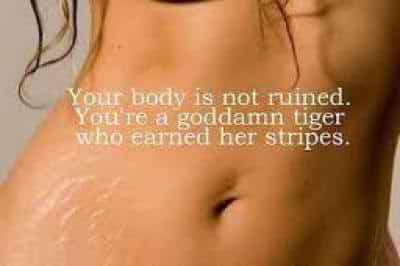
One such example shows the tummy and hips of a slender fair-skinned woman with white stretch marks on her hips. Text over the photo says, “Your body is not ruined. You’re a goddamn tiger who earned her stripes.”

Such images and articles create a social narrative that tells women can earn the right to love their bodies if they have borne children (presumably because childbirth is touted as some altruistic universal moral imperative). But, like many women, I’ve had stretch marks since I was a child. Am I supposed to hate myself for healthy pubescent growth? This narrative makes it very clear that I have not earned the right to body acceptance until I’ve fulfilled my role as broodmare.

Lest you think I’m making this up and looking for reasons to be offended, let me quote Tanis Jex-Blake in an article profiling her as one of these stretch-mark mommies who dared to stand up for herself:

I'm sorry if my first attempt at sun tanning in a bikini in public in 13 years “grossed you out”. I’m sorry that my stomach isn't flat and tight. I'm sorry that my belly is covered in stretch marks. I’m NOT sorry that my body has housed, grown, protected, birthed and nurtured FIVE fabulous, healthy, intelligent and wonderful human beings. I’m sorry if my 33 year old, 125 lb body offended you so much that you felt that pointing, laughing, and pretending to kick me. But I’ll have you know that as I looked at your ‘perfect’ young bodies, I could only think to myself “what great and amazing feat has YOUR body done?”. I’ll also have you know that I held my head high, unflinching as you mocked me, pretending that what you said and did had no effect on me; but I cried in the car on the drive home. Thanks for ruining my day. It’s people like you who make this world an ugly hateful place. I can’t help but feel sorry for the women who will one day bear your children and become “gross” in your eyes as their bodies change during the miraculous process of pregnancy. I can only hope that one day you’ll realize that my battle scars are something to be proud of, not ashamed of. 
Jex-Blake was openly mocked on the beach, which is shitty, but so is putting down others to prop yourself up.
“But I’ll have you know that as I looked at your ‘perfect’ young bodies, I could only think to myself ‘what great and amazing feat has YOUR body done?’”
You know what my young body has done? Not that body positivity or human worth are in any way dependent on individual accomplishments or others’ opinions, but my body has overcome literally crippling knee pain and persistent depression to run three half marathons, a 15-mile obstacle course, and a few score other races; raised thousands of dollars for local and global charities; and used its privilege to promote body positivity without restrictions while inspiring dozens of others to feel and do the same. Not to mention that it’s spent fully half its life suffering incessant expectations and explicit wheedling for grandbabies without regard for bodily autonomy or health, largely thanks to people like Jex-Blake who perpetuate the idea the childbearing is the single worthiest thing a woman do to validate her existence in this world.

Our society’s obsession with women’s ability to bear children as their primary purpose in life overlooks entirely those women who’ve miscarried and lost children, who are infertile, and who are transgender. Messages that tell women they’re only worthy or useful as mothers are deeply harmful.

Womb-worship aside, this “earn your stripes” narrative relies both on fat shaming and objectification by expressing pride exclusively in young, skinny, white women’s hips and stomachs.

Another viral stretch-mark image comes from Rachel Hollis (also slender, young, and white) with what’s described by supporters as an “inspiring” caption she wrote:

I have stretch marks and I wear a bikini. I have a belly that’s permanently flabby from carrying three giant babies and I wear a bikini. My belly button is saggy. . . (which is something I didn’t even know was possible before!!) and I wear a bikini. I wear a bikini because I’m proud of this body and every mark on it. Those marks prove that I was blessed enough to carry my babies and that flabby tummy means I worked hard to lose what weight I could. I wear a bikini because the only man who’s (sic) opinion matters knows what I went through to look this way. That same man says he’s never seen anything sexier than my body, marks and all. They aren’t scars ladies, they’re stripes and you’ve earned them. Flaunt that body with pride! #HollisHoliday
The problem throughout this trend is encouraging people to celebrate specific so-called “flaws” only if they’ve earned them through the martyrdom of childbearing. In this specific example, readers are eating up the message that body pride is acceptable if one has lost weight and made her body acceptably small by society’s standards, and happiness is imparted by being suitably desirable to men, and they call this “empowering.”

Case in point: The comments on the Hollis article include “Yeah, she’s hot enough for me,” and “I’d hit it.”

One wonders for whose pleasure are women’s bodies and appearance when we call statements like Hollis’s “inspirational” and “empowering?”

To quote the character Inigo Montoya, "You keep using that word. . . . I do not think it means what you think it means."

And what of those 95 percent of dieters who regain weight; what of women who never lost weight or never lost enough to become slender; what of men, who have no equivalent body positive paradigm shift as of yet? Should we just accept that not every message is useful to every person and let people take their happiness where they can find it?

NO. Not when those messages effectively harm others by lifting up only one narrow body ideal. Not when those messages hinge upon objectification and outside approval.

When I brought the tiger stripes memes up for discussion among friends, one commented:
I have stretch marks from gaining and losing weight in a short time span.
Hurray mental illness!
*throws confetti*

If we’re celebrating stretch-mark scars as proof of overcoming difficulties, why don’t we see social celebration and acceptance of scars left behind from self-harm?

Over and over we see these articles, photos, tiger stripe memes featuring skinny white women. I searched the web to find a comparable meme-type image for women of color but came up short.
Thought experiment: Do you think we’d ever see viral photos of a fat woman’s stretch marks? Or a conventionally attractive woman’s photos with the depression comment? My pics with a caption bragging about puberty-induced stretch marks? Stripes on a woman of color, on a man, on someone just in their underwear in a slum rather than sunning herself on a beach?

There’s nothing wrong with any woman’s enjoyment of her body, though the reasons given in the viral examples above are problematic in very many ways. But the greater issue is our society’s deification of childbearing and using it as validation and excuse for just more objectification of women’s bodies, assuming they otherwise fit the standards of conventional beauty by being young, slim, and white.

The “earning your stripes” message is absolutely not body positive. Body positivity is not conditional, not exclusive, not based on ability or health or size or weight loss or class or gender or childbearing or any man’s opinion of a woman’s worth based on her sexual desirability. Think twice about sharing memes that lift up a few at the expense of many.

Sunday, May 10, 2015

Flash Fiction: A Horror Story

I briefly belonged to a flash fiction writing group a while back. I only wrote a handful of pieces, and it was an interesting experience. As much as I like writing opinion pieces and telling stories about my adventures, I’ve never had any skill for fiction writing. None of my flash fiction pieces are entirely fictitious.

Prompt: Horror story
Word count: 285/300 max

It’s cold, and you’ve woken with a start.

Take a deep breath. Pause and release it slowly. Assure yourself that this feeling of dread, an icy stone in the pit of your core, was just a dream. Take another breath and listen--silence. Night slowly comes into focus as phantoms fade into memory. Shaking your head clear, you rub your arms absently. These damn drafty old stones: stately, but always so cold.

Seeking to banish and forget the fear lingering around the edges of consciousness, you think a hot tea ought to do the trick. And at the very least, it will warm you a bit. Listening a moment longer to the quiet, you muster the will with a determined inhalation and face the cool air with a brief shudder.
Disoriented a moment in the dark, you stumble, catch yourself, and fumble slowly toward the kitchen. Loud scratching startles you to a stop. Relax, just the wind in the trees against the windows. Draw a calming breath; you’re still feeling shakier than you thought.

You huddle over the warm mug, hugging it closely with a relieved smile as you take it back to your room. Sipping it in bed, you feel your body finally relax and you enjoy the stillness of the night as peaceful sleep beckons to you. Setting the mug down, you lie back and sigh, thinking of what a lovely day tomorrow will be.

Loud scratching again breaks the silence. Remember, there is no wind here at night. A steady clicking becomes louder, closer. You draw a shuddering breath and hear the mug smash just as a low growl rises beside you.

Holding your breath, you remember the dream.

It wasn’t a dream.

Friday, May 8, 2015

The Problem with Color Runs

I’ve been wanting to write a piece on how terrible color run events are vis-à-vis cultural appropriation, but desi writers have already done it much better than I could, so I’m largely going to quote and link back to them.

“Come uncultured, leave uncultured, that’s the Color Run, promise,” writes Nadya Agrawal at Brown Girl Magazine blog.

Color runs are 5k events at which participants wear white and run, walk, and dance while being dusted with colored powder, followed by a festival with more color throwing, music, and dance.

“That would’ve been an original idea if Indians hadn’t been doing it for hundreds, if not thousands of years,” Agrawal points out.

The practice comes from the springtime Hindu festival called Holi. “And at Holi, we don’t simply throw colors in each other’s faces,” Agrawal says, “it’s a place to play with people you love and revel in the vibrancy of spring.”

Prerna Abbi writes, “I’m a big fan of interfaith literacy as a vehicle for appreciation. But sometimes appreciation can turn into appropriation, and it’s important to know the difference.” (emphasis mine)

In order to determine which one the events promote, Abbi asks:
“When people go to The Color Run, do they learn about the story behind Holi? Do they learn about how this festival brings people together across faith, class, and other social lines? Do they walk away appreciating that Holi is a significant celebration for Hindus around the world? Do they know about Holi’s influence on the event at all?”

The events are undeniably appropriative. Does the value of introducing millions of people to the sport of running outweigh the impact of whitewashing this Hindu celebration, doing nothing to promote desi culture, and making obscene profits for ignorant white folk? I doubt it.

What can we do about it? We can keep writing, keep talking, keep informing our friends, and suggest alternative fun runs that feature other amusing gimmicks such as foam, zombies, obstacles, costumes, black lights, and more.

We can hope that the events will inspire some people to learn about Holi and cultural appropriation and work to make better choices in the future, as was the case for me. I didn’t think much about signing up for a Graffiti Run because it sounded like fun, but I didn’t enjoy the event because it was crowded, overpriced, and an ugly course. I later learned more about Holi and had the pleasure of attending a local Holi event, which—in stark contrast contrast to the “fun run” it inspired—was an indescribably joyful experience and for me a pivotal moment during a severe bout of depression.

I am deeply grateful for the opportunity to properly appreciate and celebrate Holi. And I hope you’ll try to do the same.

Thursday, April 9, 2015

Flash Fiction: Only Two

I briefly belonged to a flash fiction writing group a while back. I only wrote a handful of pieces, and it was an interesting experience. As much as I like writing opinion pieces and telling stories about my adventures, I’ve never had any skill for fiction writing. In fact, this one’s not entirely a fictitious account. But it’s the piece of which I’m most proud and that I spent some time revising (minimally) for competitions later. I hope you enjoy it.

Prompt: Only Two
Word count: 287/300 max

Amid the buzzing swarm, the clamor of a brass band begins a gay polka, commanding—seemingly demanding—merriment of the cacophonous crowd. Southern sun and humidity, body heat and odor press against me oppressively. I shut my eyes, touching fingertips to my temples, and exhale wearily.

A long day trekking across the faire grounds leaves me guzzling bitter, overpriced mead to calm my nerves against the serious fire hazards posed by so many thousands squeezed into a few small acres, filing through rows of aging wooden shops like cattle.

I scan the horde, searching for the so-called friends who dragged me here. They went for another round of beers while I saved seats for the next show.

“Beg ’pardon, m’lady. Do ye know the hour?” asks an ineptly affected English accent in garish tights and codpiece . . . and naught else.

Checking my watch, “A quarter of two,” I reply and grimace some semblance of a polite smile. He snatches my wrist and plants a sloppy kiss on my knuckles in thanks, dashing away before I can recoil. I wipe the wetness across my jeans and tilt my head skyward, lamenting silently, Only two?

A glimmer draws my gaze to a young couple: a kilted elf and sparkling pixie, a pretty enough pair and otherwise unremarkable. They lean into each other some 50 yards off as the tedious throng parts just long enough that I see her rise on tiptoes and him bend to kiss her: long and tender, beaming in a world of their own, and achingly intimate. I share their moment of joy from afar, raptly watching unseen, the glimpse to cherish.

Then a bellowing pretzel-bearer blocks my view, and I release the breath I hadn’t known I held.

Wednesday, April 8, 2015

Modesty is shitty

This week I had some interesting exchanges on Facebook of the body-shaming and slut-shaming variety. A now-former Facebook “friend” posted the following status:

FFF: What's with women posting pictures featuring their breasts? Do they have so little self confidence or self respect that they really have to rely on that to feel pretty or appreciated? Please women, do yourself a favor: Have a little dignity and cover yourselves.

The comments were pretty much what you’d expect, nothing particularly notable.

Another “Friend”: So to play devils advocate here ( I Dont care either way) if a woman feeling empowered by her sexuality should feel ashamed to flaunt it in fear of other people's issues? Seems a bit narrow and small. But again, I honestly do not care one way or the other. Unless they are saggy ooky

FFF: It's not the just having them happen to show, but when the picture is like boobs only, no face, I feel like the woman is saying to the world, "hi. The only thing I want you to know about me is that my body is sexy." So far as that goes, hurrah for confidence in your looks, but its women who display themselves as sex objects like that in the name of confidence who also complain about being objectified by men. I say choose one, because it's unfair not to expect such a natural reaction: It is the human nature of mankind whether or not it is cordial or proper. That's why things like modesty were invented in the first place - not to constrict women, but to cause them to be appreciated for more than their physique. I posted this not to put down women who like how they look, but to encourage them to display themselves in a way which would cause them to be treated with more honor.

Me: Maybe women post such photos without face because they are proud of their bodies and also fear being victimized by those who would share their photos unethically, seems them to her employer, etc.

Maybe they post those photos because THEY ARE THE VICTIMS of a culture that's taught them breasts are their best feature and selling trait. Then again, why are we having this conversation without mention of dick pics?

Anyone who treats a woman poorly for her appearance is an asshole. It's no failing on the woman's part that others treat her badly and judge her based on her body.

So-called modesty was forced upon women by men who owned them as daughters and wives and wanted to maintain a premium on their sexual value for trade (dowry) and status.

Suggesting that men are incapable of viewing women as anything more than objects because "human nature" is frankly insulting and ignores/excuses centuries of misogynistic cultural socialization.
Choosing to adorn and display one's body on her own terms for her own reasons it's empowering, no matter who also happens to prefer her choice in that matter.

Jfc, this body shaming, slut shaming crap is petty 101-level ignorance.

Me: Or maybe women are unique individual human beings with myriad thoughts, feelings, and motivations who deserve respect no matter their appearance.

What in the world would motivate someone to disrespect or maltreat a woman based on her choice of appearance unless that person genuinely believes women lose value and respectability by choosing to expose their ankles, shoulders, thighs, cleavage, breasts, vulva?

Me: Attitudes like this do not protect or uplift but are the cause of brutality against women around the world. http://charlottedesorgher.blogspot.com/2012/08/a-darkness-at-heart-of-bellydance.html

And then she sent me a private message to inform me that she unfriended me and deleted all my comments in the flounciest of flounces that ever flounced, over which my friends and I had a good laugh and shared lots of cleavage pics:

FFF: I love that you are so opinionated and live to be so informed on only one side of every issue. However, I'm sick of you spewing your feminazi bullshit all over my posts. For this cause i am both editing and unfriending you. If you need to copy this and contort my intentions in this message to satisfy your estrogen-propelled fury as well, feel free.

No contortions necessary, dear.

Tuesday, April 7, 2015

A narrative journal entry about past abuse

April is Sexual Assault Awareness Month, for which I am participating in the Red My Lips campaign and sharing this publicly for the first time.

Since a long absence from this blog last summer, I have a few posts elsewhere that I'll be adding and updating here as I am able. I wrote this November 10, 2014.


Not recommended for family . . . but whatever; you're adults.
CN: about 1800 words describing sexual abuse, emotional manipulation, boundary and consent violations
I’m trying to deal with something and have only spoken about bits and pieces here and there to different people. I think getting it all in one place might be helpful, though my heart now pounds furiously, just shy of a full-on panic attack.
There is no agony like bearing an untold story inside of you. – Maya Angelou
Not quite a month ago, I was at an event and a friend said to me, “Hey, isn’t that [your ex] over there?” Startled, I looked and quickly replied, “No, I don’t know that guy,” not recognizing him. A little while later he said to me, “Hey, stranger,” and I inhaled sharply. “Oh, I didn’t even notice,” I replied with false cheer and quickly walked away.
I spent the rest of the afternoon with my heart racing and barely fighting the urge to jump into my car and leave straightaway. I managed to avoid him for a few short hours until dinner, because then he sat with my friends. I pointedly ignored him and left early.
Before that day, I truly thought I would never see him again, and I was surprised by how upsetting his presence was. I was ill at ease me for days—two weeks—after that until speaking of it with complete strangers at a women’s event I attended on a whim, and there conceded that I ought to contact the friends who I believed brought him and ask them to let me know in advance if it happened again.
I sent a message to that effect, explaining that seeing him unexpectedly was emotionally too much to handle cold and asking if they’d please give me a heads up if they knew when he’d be attending future events. I was then informed that he’d recently been attending quite regularly at the Denton chapter again, from which he’d been absent since we broke up in 2005.
And since learning that, I’ve been seriously considering quitting altogether this organization that I’ve belonged to for nearly a decade. I’ve been fine with ignoring another ex at events all year, but the thought of seeing this one again makes me sick.
Our mutual friends know we dated in the past but didn’t know there was any problem. (They can see this, but I don't know whether they will.) I was 18, a freshman in college, and I was drawn by the allure of dating a dark and mysterious “older” guy (24). It was my first adult relationship, and I was oblivious at the time to how deeply flawed it was, having never seen modeled a healthy adult relationship in my life and never been taught about the concept of “consent.” I thought this was what a relationship was and that I was just inexperienced and immature. I was/am REALLY smart, and that sort of thing—emotional abuse—doesn’t or can’t happen to intelligent women like me, to good people like me.
He would frequently get me drunk and push boundaries because he (and he actually said this) got off on the idea of popping my cherry, though I’d told him I intended to wait for marriage. I was raised Catholic and had no such reservations about most other sexual contact, though, so we did fool around. And more than once he’d shove his dick in my face begging for a blowjob until I was literally in tears. I didn’t want to stick some guy’s dick in my mouth; I viewed it as shameful and gross because of the way men talk about it and talk about the women who’ve done it.
Throw some body-shaming into the mix: He told me I should do pushups because my pert, 18-year-old D-cup breasts were too "floppy." THEY'RE BREASTS! I was shocked, hurt, and shamed into silence. Anger over that remark has stuck with me since then.
I went to a camping event that summer with him and his friends, whom I’d barely met but were very welcoming, even if they teased more than I was used to. He served a shift one evening at admissions, and in the meantime I’d had a fantastic time sitting at the main campfire with one friend I knew there, listening to everyone’s stories and soaking up the good cheer.
His close friend rushed up to me and said boyfriend was upset and looking for me and was back at camp.
I went to find him and asked what was wrong. He was in a panic, said he’d been searching for me and couldn’t find me and thought the worst. I’d been with [woman friend] at the main campfire and hadn’t ever seen him pass by that area. He assumed I’d gone to fuck some other guy. He was hurt and scared and upset. I tried to comfort him: “What have I ever done to make you think I’d do such a thing?”
“You’ve never done anything to make me think you wouldn’t.”
I was shocked into silence, absolutely horrified. And, deeply hurt, I began to cry. I tried to get up to leave, but he held me—stopped me. (No, it wasn't like *that* I would later tell friends who suddenly reacted with anger.) He tried to explain away his words, blame his insecurities on the ex-girlfriend he’d wanted to marry before me. Once I’d managed to calm myself, I got up again to go to the bathroom I told him. “But you’re coming back, right?” he pleaded. I wanted a little space to breathe for a few moments, but I don’t think it had occurred to me not to return until he said that. And I placated him with an affirmative response.
It was a long walk and I felt numb. I saw one or two of our friends between the camp and toilet. His friend told me that boyfriend had been talking some craziness about packing everything up and catching a bus back home that very night because he was so upset, thinking I had left him. He would have stranded me. I didn’t want to go back to him, but I didn’t know what to do.
I now know that I would have been taken care of, that his friends are good people, but I didn’t then. I didn’t see any choices but to . . . I don’t know—beg his forgiveness for the imagined betrayal?
I stayed with him—we were in love, right?—but tried to break up with him about a month later. I was resolved, but somehow he talked me to tears again, reminding me that we loved one another, something crazy about emotions and not-quite guilt-tripping me into a “break.” I ultimately conceded in the hope that I could at least leave his damn house sooner. (I was living on campus but stayed over with him a lot. God, I HATED his fucking water bed. My back was always wrecked by it.)The typical pain of a breakup haunted me for a few weeks and months afterward, but I was OK then. He tried “befriending” me a few times a few years later. I took him at his word and treated him as such, but he hid his disappointment at my casual disinterest poorly.
I never wanted to be a victim. I never wanted to use that word. After escaping that relationship, I recognized and named the emotional abuse for what it was. But I never used that word. And I read a lot of stories from a lot of women very like me, but I didn’t use the R-word either. It didn’t seem to fit, and I couldn’t manage the implications if I called it that. Either I’d be appropriating a word and status that didn’t belong to me, because it wasn’t like he forced me. I eventually gave in and had sex with him for my own reasons, or that's what I tell myself. But he'd been pushing for it for several months. 
The fact is: coerced consent is not consent; resigned consent is not consent; and impaired consent is not consent (such as by alcohol).
He was always speaking of his sexual experience and prowess as if he were God’s gift to women, and I’d laugh and demure, since he knew I didn’t want to have sex with him. When we finally did it, I remember thinking to myself, “Well, if this is how great sex is, I guess I’m going to spend my life rather disappointed.” It didn’t nearly match his hype, but how was I to know any different?
Only more recently have I been able to name the manipulation and sexual abuse for what it was. I want to believe that talking about it can help. Recent events have triggered a lot of remembered hurt and there may be a lot left unprocessed because I didn’t want name it for so long.
I hear through the grapevine that he’s a different person now. There’s an unstated societal expectation that I (that anyone) should let go, forgive and forget. Our mutual friends don’t know most of this story, and I don’t know whether I ought to tell them.
Whoever he is now and whatever he’s been through doesn’t change what happened, and it doesn’t change how it’s ruined a big damn part of my past, present, and future relationships. I’m not obligated to forgive anything. Forgiveness is a gift of absolution to the wrongdoer. It doesn’t do anything for me.
From Skepchick commenter LeftSidePositive: This focus on “forgiveness” can also mean that the person who was wronged might be pressured out of making decisions in their best interest–for instance, someone might have “moved on” after someone stole from them–but by conflating this with “forgiveness” they can be guilted out of taking precautions not to let them be vulnerable to theft from that person again. And then the conflation goes the other way too–when someone in the social circle implies that the wronged person is unhealthy and hasn’t “moved on” enough when they take reasonable precautions having learned from being wronged. . . . As such, an abusive person can simply wave our cultural imperative about forgiveness and continue the cycle of abuse, all the while enablers are insisting that the wronged person is actually more “empowered” by “forgiving” and remaining vulnerable.
I don’t know what’s going to happen now. I don’t know what I’m going to do next. Painful though it may be, I think that remembering all this is a necessary step in validating my present feelings and desire not to see this person or be around him ever again. (Aside: What the hell kind of fucked-up socialization does this society have that I feel the need to write 1800 words validating my fucking feelings?) But my feelings are a bit calmer now, at least.
April update: I still go, though not as often. I've had to interact with him in a professional manner because of positions in which I've volunteered to serve the organization. I'll be attending a weekend-long immersive event and will see him frequently because we're both competing in the same competition and typically camp with the same people.
I can no longer camp with my friends because it's not a safe place for me to be any more, and I don't know where I will end up this weekend. This is causing no small amount of daily anxiety leading up to it.
I expect to need a long break after the event. And that will undoubtedly hurt my opportunities for advancement in the organization. Twisted. But I have other things going on in my life that I enjoy pursuing. That's what I tell myself to lessen the hurt and disappointment.

I don't know what else to do.